Global infrastructure failures cost the economy over $2 trillion annually, with many being caused by delayed inspections or undetected errors.
What if intelligent aerial systems can spot these errors before they turn into disasters?
With air robotics and drones, this is soon becoming a reality.
Today’s critical infrastructure, including power grids, transportation networks, pipelines and telecommunication towers, command continuous monitoring, maintenance, security, and quick response to any oversights. Traditionally, a lot of these tasks have been extremely labor-intensive, dangerous, and even costly. However, the rise of Air Robotics and Drones is transforming how industries inspect, protect, and sustain vital systems.
While the two terms are often grouped together, they serve very different roles. Drones are usually remote-controlled or semi-autonomous, whereas air robotics involve fully autonomous systems backed by AI and swarm intelligence. These two, together, are changing the game across varied industries.
Air Robotics: The Future of Autonomous Infrastructure Management
Air robotics refers to advanced aerial systems that integrate artificial intelligence, machine learning, swarm intelligence, and automation to perform tasks independently. These systems are highly effective for large-scale infrastructure projects/ processes that require real-time data analysis and autonomous decision making.
How Can Air Robotics Enhance Critical Infrastructure
- Autonomous Inspections and Predictive Maintenance
- Air robotics systems use AI-driven sensors, LiDAR, infrared imaging, and computer vision to inspect bridges, railways, and power lines for structural weaknesses and potential failures before they become catastrophic, all without human intervention.
- Example: AI-powered air robots used by power companies detect overheating transformers and corroded electrical lines, preventing blackouts before they occur.
- Swarm Intelligence for Scalable Operations
- Air robotics can function as intelligent swarms, independently mapping large facilities like oil refineries or underground tunnels, to identify weak points or high-risk zones.
- Example: In Oil & Gas refineries, swarm robotics assess structural integrity and enhance real-time risk assessment without interrupting operations.
Drones: Versatile, Agile, and Rapidly Deployable
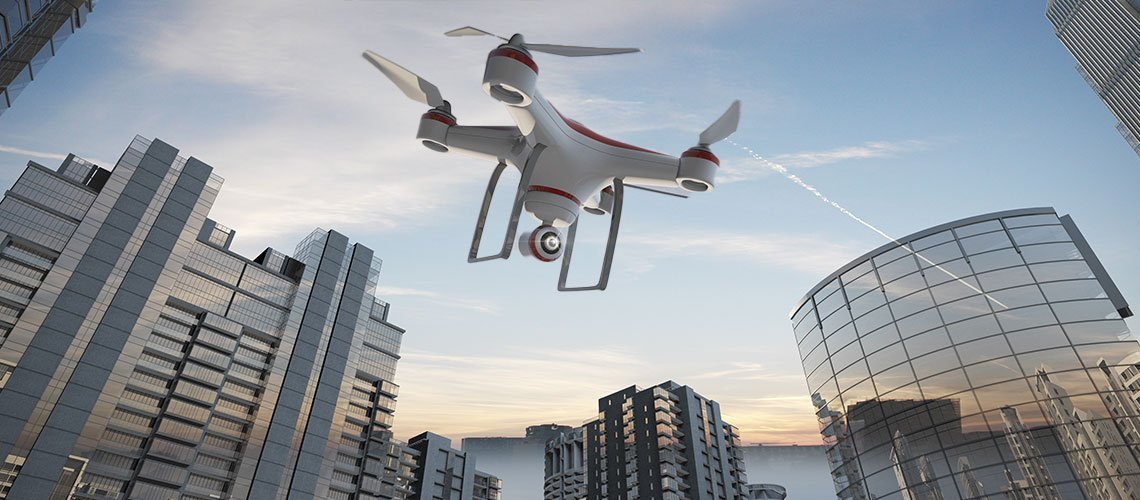
Drones, or Unmanned Aerial Vehicles (UAVs), are the more familiar face of aerial tech. Considering their ease of deployment, flexibility, and affordability, they are widely used in infrastructure management. They may not be fully autonomous like air robotics, but offer benefits like high-quality aerial surveillance, mapping, and emergency response capabilities.
The Edge Offered By Drones For Infrastructure
- Fast and affordable inspections
- Drones equipped with HD cameras and thermal sensors perform inspections of bridges, roads, and transmission towers, minimizing the need of costly manual checks.
- Example: After natural disasters, utility companies use drones to assess damaged power lines, restoring service faster than traditional manual teams.
- Emergency Response and Real-Time Monitoring
- During disasters or emergency situations, drones provide immediate situational awareness, transmitting live footage to command centres and emergency teams.
- Example: Search-and-rescue teams use drones with thermal imaging to locate victims trapped in disaster areas where access is limited.
Air Robotics vs. Drones: Different Strengths, Shared Mission
While both technologies are critical, their capabilities diverge depending on the mission scope. Here’s a snapshot of their varied applications.
| Feature | Air Robotics | Drones |
| Autonomy | Fully autonomous, AI-driven decisions | Remote-controlled or semi-autonomous |
| Scalability | Operates in swarms for large-scale tasks | Best for localized, quick inspections |
| Cost | Higher upfront investment, long-term savings | Lower cost, easy to deploy for smaller tasks |
| Best Use Case | Complex infrastructure, predictive analytics and maintenance, disaster response | Quick inspections, security patrols, emergency response |
Challenges And Considerations
While air robotics and drones offer a multitude of benefits, their adoption comes with its own set of challenges:
- Regulatory Compliance
Navigating the airspace regulations, especially in urban or restricted areas, continues to be tricky and varies by country.
- Data Privacy and Security
Aerial surveillance raises concerns around data protection and the management of sensitive infrastructure footage or information.
- Operational Limitations
Circumstances like harsh weather conditions, limited battery life, and connectivity issues can hamper drone and robot performance.
- High Initial Investment
Especially for air robotics systems, the upfront costs can be substantial, requiring a clear strategy for return on investments for long-term adoption.
Like any technology, careful implementation and strong governance are crucial to maximize value while minimizing risks.
Final Thoughts
Both air robotics and drones are truly reshaping critical infrastructure management. Air robotics offer unmatched autonomy and intelligence, supporting large-scale, complex operations. On the other hand, drones provide fast, flexible, and affordable solutions to assist in immediate inspections and monitoring activities. As both technologies evolve, the synergy will lead to smarter, safer, and more efficient future for infrastructure management worldwide.